

Pre-Mortem in a GCSE classroom


Pre-Mortem

I really like reading Alex Quigley’s words (I can feel my colleagues’ knowing-eye-rolls!).  I have frequently taken opportunities to share his articles and views in our T&L Briefings and Developing Pedagogy meetings and RPCC teachers are an accommodating and patient group so I have been getting away with indulging my loyalty to the author of ‘The Confident Teacher’ for quite some time now!Alex Quigley

So, I was very interested to read an article in a TES publication – ‘Ruminating on Research’ wherein Alex Quigley writes; “Only by analysing what went wrong can we know if future projects will sink or swim”.  He refers to a pre-mortem linked to the premise that we can anticipate why our efforts might fail in order to plan for success and most importantly for progress.

I first learned about this strategy at the PiXL conference in January and was enthusiastic about trialling it with my Year 11s and this is what I know (it is hopefully also what our Headteacher and Head of English now know and can verify as they joined my lesson on this day as part of a Curriculum Learning Walk!):

 “We must quietly focus on failure if we are to do our best”

My Year 11s are a wonderfully reflective bunch!  Not passive but modest enough to be open to discussions about their strengths and targets and as I have had the amazing opportunity of training them up since Year 9 I think apart from this being one of the most fulfilling and satisfying teaching experiences for me, they have learned to know each other fairly well over time and are far past the need to ridicule or berate each other for misunderstandings or low marks that they have all inevitably encountered along the way.

We have completed the GCSE course for both Language and Literature and I’m confident that I have provided them with all the skills that they need to sit these papers but…amongst the many pages of many exercise books completed and marked over the course…which targets and notes should they prioritise and do they even know how to?

What I mean here is that I am confident in their confidence in theory…but nothing can be left to chance in the final stages of their GCSE preparation.

“…focus on likely indicators of failure”

I’m a big marker – I believe in quality written feedback that is regular and personalised and I still believe (after 21 years in the game!) that my students deserve quality written feedback because if I require them to produce high quality responses in my class surely they should require me to mark and evaluate it? (I also realise that this is a very unpopular mantra in the current climate!)   Anyway… I digress – in my enthusiasm to set targets and offer up advice in my students’ books I have perhaps not afforded them the time needed to react and respond to my action points and for this they need time to condense.  After a bespoke lesson on condensing skills wherein the whole class audited their exercise books to select the salient points within my marking and prioritised their targets they were ready to conduct a pre-mortem!
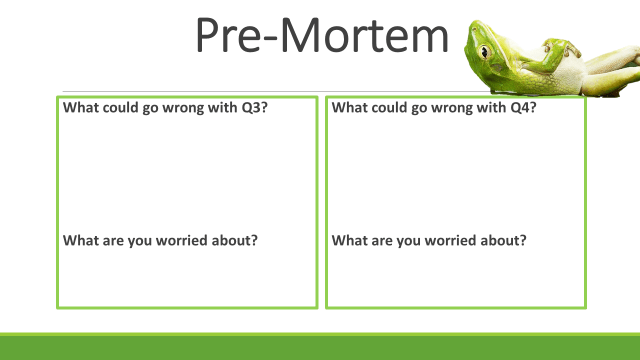
pre-mortem 2

“…anticipate why our efforts might fail”

Evaluating their likely responses to both GCSE Language Papers using a pre-mortem turned out to be a wonderfully successful exercise.  As is often the case teenagers surprise us with their adaptability and ability (I suppose these are just two reasons why teaching teenagers is so brilliant) and in a seminal moment I realised that they were in fact acutely aware of and able to manage their own targets and could confidently articulate their concerns and needs.  I now keenly understand what they need and as part of their honest reflection we have agreed their personalised targets:

 “we can better plot our next steps and face failure with a plan”

My planning for next half term revolves entirely around their identified priorities rather than my plan for their exam preparation based broadly on my evaluation from my marking – seems obvious, I know!  As for the marking: this will make things much more interesting because I will be teaching finely tuned differentiated lessons and therefore marking a range of exam questions instead of 30 carbon copies!

I recently wrote and posted about student wellbeing (‘I sing Silence As Loud As I Can’: rpccteachingandlearning.school.blog) and even though my Yr 11 students didn’t get to lie on the floor in the Drama Studio and partake in ‘mindfulness’ activities, I do think this has been their version – I took the time to consider the things that they were worried about linked to our GCSE papers and in turn, they taught me how to plan more effectively and more considerately for them.


 

‘I sing silence as loud as I can’

The Importance of Student Wellbeing

Like many schools we’ve been carefully considering staff wellbeing at RPCC and taking action to ensure that we regularly address it in an open forum. But what about student wellbeing? We have an amazing pastoral team that monitor and support our students though recently I have been considering what can be done in our curriculum time to support student wellbeing and this is what I know…

From reading: https://singteach.nie.edu.sg/issue64-bigidea/

Two big reasons (for discussing & promoting student wellbeing as a priority) emerge. One is the recognition that schooling is about much more than academic outcomes. Second, students with high levels of wellbeing tend to have better academic and life outcomes, in school and beyond.

Ask any member of staff at RPCC and they will know and understand this correlation but I am wondering if we should take more time to explicitly plan for our students’ wellbeing within our curriculum areas. In response to Student Voice RPCC have recently prioritised the charity Young Minds and I was interested to read that: In March 2017 YM carried out a survey of 452 children and young people aged 11-18 on behalf of the Health and Education Select Committees to support their joint inquiry into mental health and education and they found that 81% of young people said that they would like their school or college to teach them more about how to look after their mental health.Young Minds

We are all aware of the necessary increased focus on our students’ mental health and wellbeing and teachers are expanding their skill sets in order to support students experiencing a wide range of mental health issues, but perhaps we can do more to open the debate within our curriculums.

From reading: http://www.isams.com

“Stress-related mental health conditions are one of the most talked about barriers to learning in recent years”

Of the 5 suggestions emerging from this research (which explored wellbeing strategies being delivered in schools around the world) this one caught my attention:

Mindfulness lessons:

“In schools around the world some children are taking 10 minutes out from the hustle and bustle of the school day to reflect on their thoughts and feelings…while others concentrate on their breathing; a technique known as mindfulness.

In its simplest terms, mindfulness helps train your attention to be more aware of what is happening in the present moment, instead of worrying about what has already happened or might happen in the future.”

With this in mind I designed a lesson within the English curriculum for one class, as a trial and this is what I learned:

I know my Year 8 class are fabulous! We work hard to maintain our routines for excellent behaviour for learning, they pay attention to my targets for academic progress, they hand their homework in and they sit in rows…every lesson. But have I planned explicitly for their wellbeing so far this year…

This week I took them on a journey out of their classroom on the English corridor and we spent our time together in the Drama Studio.

The lights were dim – their shoes were off – they laid down in a space on the floor (incredibly none of them questioned my decision to change their learning environment so dramatically and that is just one of the brilliant qualities of our students – they are always happy to try something new!).

In the silence of the Drama Studio I realised the opportunity I had to support my students’ wellbeing.

Now, I have watched Mrs Freeman teaching meditative relaxation in Drama and I am not claiming to be an expert but armed with my instructions from the expert I quickly found my confidence! My lively Year 8 students who normally spend the first moments of my lessons fizzing with the after-math of breaktime dramas or struggling to stay still in their seats as they battle to control unspent energy were quickly relaxed – it was enlightening to observe their commitment to deep breathing exercises and far-away-escape-story-telling! (I flew them out over Southampton Docks…across the Channel…and far far away to a tropical island where they played in the sea and laid on the sand!).

There was no noise…no fidgeting…no movement apart from their toe-wriggling in metaphorical sandy beaches! When I gently brought them back to reality they were relaxed…completely calm and spoke in very quiet voices…it was fascinating.I go quiet image 1

I sat on the floor with them…they shuffled round me and I read them a book I had bought especially for them: “I Go Quiet” by David Ouimet. There was no chatter…no wriggling…no fiddling…it was like magic! I asked them how they felt…they said they felt calm and relaxed – it was a moment to enjoy!

I am well-accustomed in noticing the powerful impact of literature on students but rarely have I been so convinced by a text. “I Go Quiet” is a beautiful and powerful story of a little girl’s struggle to find her place in school and in the world.I-Go-Quiet-image 2

I didn’t analyse the language, though – explore the context – discuss the impact of the writer’s message (very unusual for me to resist!). Instead I asked them to draw their interpretation of the messages in the text. They didn’t question, delay, chat or pontificate instead they found a space and quietly got to work. It was an entirely different lesson – I hardly spoke other than to check they were OK and when the bell went – they asked to stay!

Back in the classroom the next day we discussed the lesson and I learned that they had valued it and claimed that they had enjoyed the pace and the quiet and we shared their creative outcomes. I don’t think that mine is a model upon which to build a ‘mindfulness’ curriculum and I am aware that on the basis of one lesson’s success I can’t claim that this needs to be an embedded ‘event’ in our curriculum but what it has taught me is that I need to be more aware of my students’ wellbeing needs and that they appreciate me knowing this and acting upon it…even just for a lesson every other week.

The National Children’s Bureau poses the question: How can schools promote student wellbeing? And the response from teachers across the country looks like this:

  • Be open and positive about promoting wellbeing
  • Develop a supportive school and classroom climate and ethos which builds a sense of connectedness
  • Promote the acceptance of emotion and vulnerability, warm relationships and the celebration of difference.

I am proud of and confident in the quality of student-staff relationships at RPCC – at the heart of our school community is care and compassion but perhaps what I now also know is the need for us all to take a moment in time and just breathe…

In pursuit of discomfort…

ChemistrySo, I have been reading a publication called ‘Education in Chemistry’…I know!  This is an unusual venture for me but one of the most brilliant things about teachers at RPCC is their desire to collaborate and also their enthusiasm for academic research…

The article that Mr Grainey passed to me is entitled: ‘In pursuit of discomfort’:

“If students are at ease, they’re not necessarily learning much…” claims Editor Paul MacLellan.

MacLellan ponders the idea that most teachers would associate ‘enjoyment with engagement’ and ‘engagement with learning’ based on the premise that if students enjoy a subject they will invest more and therefore ultimately achieve higher grades – however, the wealth of academic research available exploring student motivation could prove that our assumptions are often wrong in this area…most studies actually conclude that students like their teachers more when they learn less…

The article cites a study that looked at undergraduates at a prestigious Italian University which concluded that students ranked those teachers who ‘simply’ taught to the test more highly than those teachers who sought to enrich their students’ preparedness for the world beyond education…

Is it as simple as assuming that when our students feel more comfortable they feel more positive?  This idea is particularly interesting for RPCC at the moment as we explore our strategic plans for collecting whole-school Student Voice data…the necessity for a standard set of questions seems particularly pertinent with this in mind if a bias linked to ‘popularity’ is to be avoided?

MacLellan refers to a study published in ‘Chemistry Education Research and Practice’ which examined students’ wellbeing linked to the outcomes of lessons that made them feel uncomfortable.  The researchers ran an extra-curricular non-compulsory programme which developed students’ abilities to think in different ways – to enhance insight through evaluative discussion and supported collaborative reflection – the findings are interesting:  students felt ‘safe’ in the philosophical discussions and the process easily facilitated the ‘discomfort necessary for learning’.

Student-teacher relationships at RPCC are a real strength and it’s certainly true that Student Voice data indicates that when students like and invest in a subject it is commonly because they feel positively about their teacher – but perhaps this article raises the question – do students need to like their teacher in order to make progress…?

Miss…your clock’s not working…

I know!

It isn’t working and whilst it’s been broken I have embarked upon an accidental research project inside my own classroom…

Since the batteries of my classroom clock gave up in December (around about the same time that my tired-teacher-batteries were also feeling quite drained!) students in all my classes have been asking about my clock…so many times each day…every lesson…many times in the same lesson!  I had absolutely no idea that my students were so doggedly staring at time during my lessons – distracted by their break-time count-down calculations…gawping at the minutes…assessing how much commitment they would afford a task set for them to complete ‘by the end of the lesson’ – shocking…and not very flattering!

I have resisted the clichéd teacher responses passed down and learned over the course of my career:

“The bell is for me…”

“I’ll be the one to monitor time in my lesson…”

The lesson will finish when …blah, blahhhh”

Instead – I turn to the pages of Academic Research to explore the insights linked to distraction of many practitioners before me and this is what I have found…

Peps Mccrea – ‘Memorable Teaching’ – is absolutely brilliant!

“Our job as teachers is to increase the life chances of our students by helping them develop more powerful long-term memory (LTM)”

Mccrea presents the theory that our goal in teaching is to manage not only what students do in the classroom but to manage what they think – because “ultimately, what students think about is what they learn…”.  Since my own clock-awareness-gate I’ve been considering Mccrea’s 9 Principles of memorable Teaching and this is what I now know…

1: Manage Information – “schools are information-rich environments – our classrooms are overflowing with data…”

So, I have completed an audit of my classroom (new to me this year, so an opportunity for me to create a new space for learning….curiously I have reverted to type and filled every place available with something shiny and interesting!)

  • every wall covered with information/examples/instructions
  • every display-board groaning under the weight of GCSE AOs/student work samples
  • window-ledges…covered with student work examples etc. etc.

Sounds great?  But is it?  Is it a confusing and (slightly claustrophobic!) eclectic cacophony of information?!  What is it like for a learner to be in Room 9…  Mccrea suggests the following factors for consideration of the physical environment:

Clocks – A classroom clock in plain-view can easily trigger “tangential trains of thought”…Ah haaaa!  I knew it (sort of!).  No more ticking-time-distractions in my classroom, those batteries are never getting replaced!  During a quick classroom circulate this morning around our school, I see that some classrooms are displaying several clocks…imagine!

Music – “the only time when music helps us think is when it offsets the impact of other greater distractions”.  The use of headphones by our students in lessons has long been debated at RPCC – the answer is surely a ‘no’ – our Learners do not require any further distractions in a learning environment?

Displays – unless they detail information needed every lesson they are merely a distraction…this is sad…no more ‘Miss Reed’s favourite Richard 3rd Quotations (a text currently not on any GCSE spec.!)?

2:  Orient Attention:  “Attention is the currency of our classroom”

To orient our students’ attention actually means going against instinct – for example – I added a very lovely green frog reclining hilariously on the first line of my Year 11 resource last week – necessary?  No. …ingrained in me to make my resources visually attractive…yes!  But – we did then have a funny conversation about that frog…this was not linked to progress!  I see Mccrea’s point…

3:  Streamline Communication:  “How we communicate influences what gets learnt…”

Key messages delivered verbally linked to new or re-visited knowledge can be re-iterated on succinct classroom displays as long as that information is relevant every lesson…otherwise our messages may become confusing and/or over-whelming?

4:  Regulate Load:  “Learning happens when students have to think hard”

We have completed T&L Briefing CPD on Failed Transfer very recently – so we are all aware of the value of making simple, obvious and relatable connections within and between GCSE AOs – so Mccrea has (another) great point.

5:  Expedite Elaboration:

Now, this I can get on board with – fancying myself as a fairly capable raconteur!  Mccrea suggests that Mnemonics, rhyme, stories and letter-linking form the basis of any successful classroom display/resource – so we just need to think carefully about using any surplus resources that simply cause distraction – seems like it could actually reduce work-load..?

6:  Refine Structures:

We are all adept at ‘refining’ but perhaps can easily get out-of-practice?  Mccrea reminds us to consider how ‘new knowledge’ can be linked to similar concepts already learned (back to Transfer).  Planning that makes prior learning explicit is therefore more likely to afford progress and if learning ‘journeys’ are displayed to aid Working Memory  in converting to LTM – simple, right?

7:  Stabilise Changes:  ” Spacing…is one of the quickest wins available for teachers wishing to supercharge their impact…”

So, we can cover up displays…then reveal displays when required – I have seen this done and the nodding recognition from around the classroom as students recall and recognise was impressive.  The learning environment thus becomes an interactive one and promotes cultures of impactful low-stakes testing.  This would increase the value of all of those time-stealing displays that we religiously produce to entertain and support our students?

8:  Align Pedagogies:  “Carve every word before you let it fall” (Holmes)

I’ve seen the ‘Me-We-You’ strategy utilised in a variety of classrooms across RPCC – if we reduce Mccrea’s research to a central idea for implementation perhaps we could all adopt one sign for display reminding students of their lessons wherein they were exposed to this strategy (‘Me-We-You’) and this could facilitate a cognitive link to LTM and trigger learning based on memory of what has been learned in that process..?

9:  Embed Metacognition

Mccrea suggest that to calibrate understanding perhaps this mantra may be displayed (I know I’ve said we’re to whittle down displays…but…) could we try this in each classroom:  Predict.  Evaluate.  Reflect.  We are aware of and utilise these metacognitive skills in isolation in our teaching but drawing them together can only improve learning?

So – a basic summary of Mccrea’s work and it’s clear that some of the strategies are firmly embedded in our practice at RPCC…some need further discussion and research but many of them are quick and easy to implement.  Is it as simple as taking down classroom clocks?  Well, yes – as a starting point.  As for tearing down the multi-coloured meanderings adorning the walls of Room 9…I’m not quite ready!


Failed Transfer

Failed Transfer 1

In the first T&L Briefing of 2020 I delivered some research on Failed Transfer – this was one way to shake off the sleepy chocolate-coma of Christmas!

What can teachers do about the impediments to the successful transference of competency from one domain to another?

At RPCC we have been exploring the AO skills that are common amongst GCSE subjects and so far our work has linked:

English + Music

English + RE

English + History

(Bet you can’t guess which subject I teach?!)

Our endeavors have provided heartening success born-out in the data from each of these GCSE subjects – our hypothesis being:  if our students have the knowledge to apply the skill of evaluation in English, why can’t they apply it in each of the other subjects that require the same GCSE skill?

We coached Year 9, 10 and 11 students in class – we presented a WTM in the hall and we marked their papers cross-curricularly and the results were powerful.  So, with the success of this in-house study still fresh in our minds this particular piece of research seemed pertinent.

The research reminds us that, at the centre of all that we do and teach, we are united in our belief that the education we provide fortifies the whole child and should give them skills required beyond the classroom: for family…society…the economy.  Certainly at our school we have designed academic and pastoral provision that seeks to embed collaborative skills, creativity and critical thinking to support our children in their readiness for the world.

This research breaks down the elements of Failed Transfer in to three areas (which is perfect for a 10-minute T&L Briefing slot!):

1.Knowledge:  this particular element of Failed Transfer struck a chord – should we be afeard to incorporate learning by rote (incidentally, Student Voice at RPCC has indicated that there is a high level of enjoyment and reassurance in the regular low-stakes testing that is fuelling the start of many lessons at our school each day). We were reminded that Knowledge precedes skills – obviously, and that Critical thinking cannot happen unless sufficient factual knowledge is obtained. Without Knowledge embedded (by whatever means) Failed Transfer is inevitable – should we go back to basics lest we forget that we have the subject knowledge that our students require – our job is not to entertain (unless it comes naturally, of course!) but to impart the knowledge required before the skill can be taught…?

2.Contextualisation:  Take collaboration…

When performing surgery, collaboration requires individuals to apply their respective expertise in order to achieve a specific outcome. This often requires assertive communication with little regard for open debate.(Green & Johnson – Interprofessional collaboration in research education – )

Teachers at RPCC will regularly endure my proclamations about the importance of collaborative work within our classrooms – encouraging our students to discuss, engage and consult on a given subject is a worthy skill for life but…to avoid Failed Transfer:

  1. Knowledge (must be embedded first)
  2. Knowledge is then Synthesised
  3. Contextualised then…
  4. Skills will emerge

3.Adaptation: Perhaps most powerful is this piece of academic research from Chase & Ericsson which details a 2 year memorisation study involving 2 teenage boys (we’re still wondering how they were persuaded to start – let alone remain – in such a lengthy and perhaps not very exciting study?!) and their task was to learn a sequence of digits. They were instructed to practise for 3/5 hours a week (I know…imagine if some of our students committed to any form of independent study for 3/5 HOURS a week?!) and at the end of the 2 years the boys were able to recall 70 digits, compared with 7 at the start of the study. However, when asked to switch to reciting a sequence of consonants believing that the skill of memorisation had been acquired, the boys reverted back to only being able to recite 7 so…

  1. Effort and engagement in learning a new skill must be taught
  2. Automaticity kills adaptation
  3. Repeating same skills (behavioural/academic) in many settings will improve adaptation.

Is it all about routine & high expectations…?  The discussions in our Briefing would suggest yes – but the knowing this is the easy part!

What has been most interesting is the response to the idea of adapting behaviour skills – what is learned exemplary behaviour in one classroom can be adapted to all classrooms if the same set of systems and routines are consistently adhered to, it would seem. And one Maths teacher has endured a steady stream of visitors in to her classroom this week to observe the impact of teaching behaviour for learning skills that ensures a calm and productive classroom environment – but this was no easy task and her endurance and strength of belief in the importance of teaching behaviour for learning skills every lesson has only now paid off – the students are able to adapt these learnt skills to any/every Maths lesson.

Learning is the only freely transferable skill we know – those who know how to learn effectively and efficiently will succeed in any novel situation:

It’s always more rewarding to deliver research that has a concrete suggestion for application at its conclusion and this research did just that for us!  So, the take away message:

BE EXPLICIT:  ask your students

  • Where have you seen this material before?
  • How is this similar or different to what you learned last week?
  • What previously learned skills do you think might be relevant here?

And finally – Practise & adapt similar skill sets across varied domains and contexts including Curriculum areas and within and between Pastoral teams.


From Bulletin to Blog!

RPCC T&L Bulletins:  regentsparkcollege.org.uk
  • Since its conception in 2016 we have long debated the value of producing a T&L Bulletin at Regents Park. 
  •  
  • The Bulletin has grown substantially over the last 3 academic years fortified by articles and observations volunteered from a wide range of teaching staff at our school – each offering as valuable as the next and at its peak the Bulletin grew from an original 2 pages to a whopping 32 jam-packed pages of:


  • Academic research (in-house as well as in response to findings in the wider context)
  • Collaborative outcomes both in school and across Southampton
  • Curriculum strategies
  • Innovation
  • Creativity and so much more…

So, why change the format?  The popularity and interest of our Bulletin is gaining momentum (which is hugely flattering).  It’s important to thank those of you who write to discuss the content of each publication or who contact me directly to chase the date of the next edition!  It’s wonderful to be a part of this wider collaboration and so with this in mind we will ring in the change at the dawn of a new decade and re-model the face of our technicolour text…but not lose any of the content!  In fact the RPCC Blog will facilitate more frequent updates, reach wider audiences across the educational community and encourage valuable discussions.